Salesforce to Microsoft Power Platform
Reduce Salesforce TCO by 30 to 70%Salesforce
Assessment & Extraction Tool
Scan, extract, and rebuild. From Salesforce to Microsoft Power Platform - partner-led, AI-driven, at a fraction of the licensing cost.
Whether your Salesforce footprint is one production org with twenty custom objects or a sprawl of sandboxes, managed packages and bespoke Apex, the tool handles all three steps at industrial quality. Inventory every object, Flow, Apex class and Lightning Web Component across your org. Extract every record, attachment, file and design element in portable form. Let AI generate the modern replacement on the right Power Platform target - Model-Driven on Dataverse, Canvas on SharePoint Lists, or a Code App for the heavyweights - with data already migrated.
See the full Assess - Extract - AI Migrate cycle in 3 minutes:
The Challenge
Salesforce is a cost centre
Licensing Math
Salesforce Enterprise sits around $165/user/month, Unlimited around $330, Industry clouds higher. A 500-seat org is a multi-million-euro annual line. Microsoft Power Apps Premium is roughly $20/user/month with everything Dataverse-shaped already included if you are on Microsoft 365.
Vendor Sprawl
Most enterprises already run M365, Teams, SharePoint and Power Platform. Running Salesforce on top means two identity stacks, two automation engines, two reporting models, two AI assistants. Consolidation is the quiet conversation in every CIO's office this year.
Apex Skill Scarcity
Senior Apex / LWC developers are expensive, hard to hire, and the talent pool is shrinking. The team who built your custom layer five years ago is not the team you can bring back when something breaks - or when you need to extend it.
Years of Records
The bigger problem is the data - years of Accounts, Opportunities, Cases, Contracts, custom-object records, ContentDocument files, audit trail. None of it migrates itself, and most of it will not survive a sloppy export.
Three Paths, One Tool
Not every object should be rebuilt
Some custom objects haven't been touched in years and just need their records archived. Some are simple enough to lift onto a Dataverse table with a Canvas screen on top. Only a few are wrapped in Apex, Flows and LWC that genuinely need rebuilding. The hard part is knowing which is which - and that decision usually sits inside the head of whoever built the org a decade ago. The Assessment & Extraction Tool classifies every object in minutes, so you spend your migration budget where it actually matters.
All three paths run on the same extraction engine underneath. Same fidelity, same tooling, different downstream treatment.
Archive
For custom objects whose records are no longer actively updated but whose data must survive. Compliance retention, audit trail, regulator handover. Records, attachment URLs, and history are extracted to a queryable SQLite archive - no rebuild needed.
Typical signals: no record changes in the last 12 months, stale Flow associations, no active page-layout assignments.
Lift
For objects with simple structure but ongoing use. Flat schema, a few page layouts, light validation rules, no Apex. These map naturally to Dataverse tables with a Model-Driven app, or to a Canvas app on SharePoint Lists - fast, lightweight, no over-engineering.
Typical signals: small T-shirt size, fewer than ~30 custom fields, no Apex triggers, minimal Flow involvement, single record type.
Rebuild
For objects with real business logic that need to keep working. Apex triggers, Flow orchestration, LWC, Visualforce, integration callouts - the kind of object where "just export the records" would lose 80% of what makes it useful. AI rebuilds the full application on the Power Platform target of your choice, data included.
Typical signals: Apex triggers / classes, multiple Flows or LWC components, dozens of validation rules, integration callouts, custom UI.
Overview
Know Your Salesforce Estate
Before you can modernize, you need to understand what you have - and then get the data out cleanly. The Salesforce Assessment & Extraction Tool gives you complete visibility into your org, extracts the records that matter, and then uses AI to generate a fully functional replacement on Microsoft Power Platform.
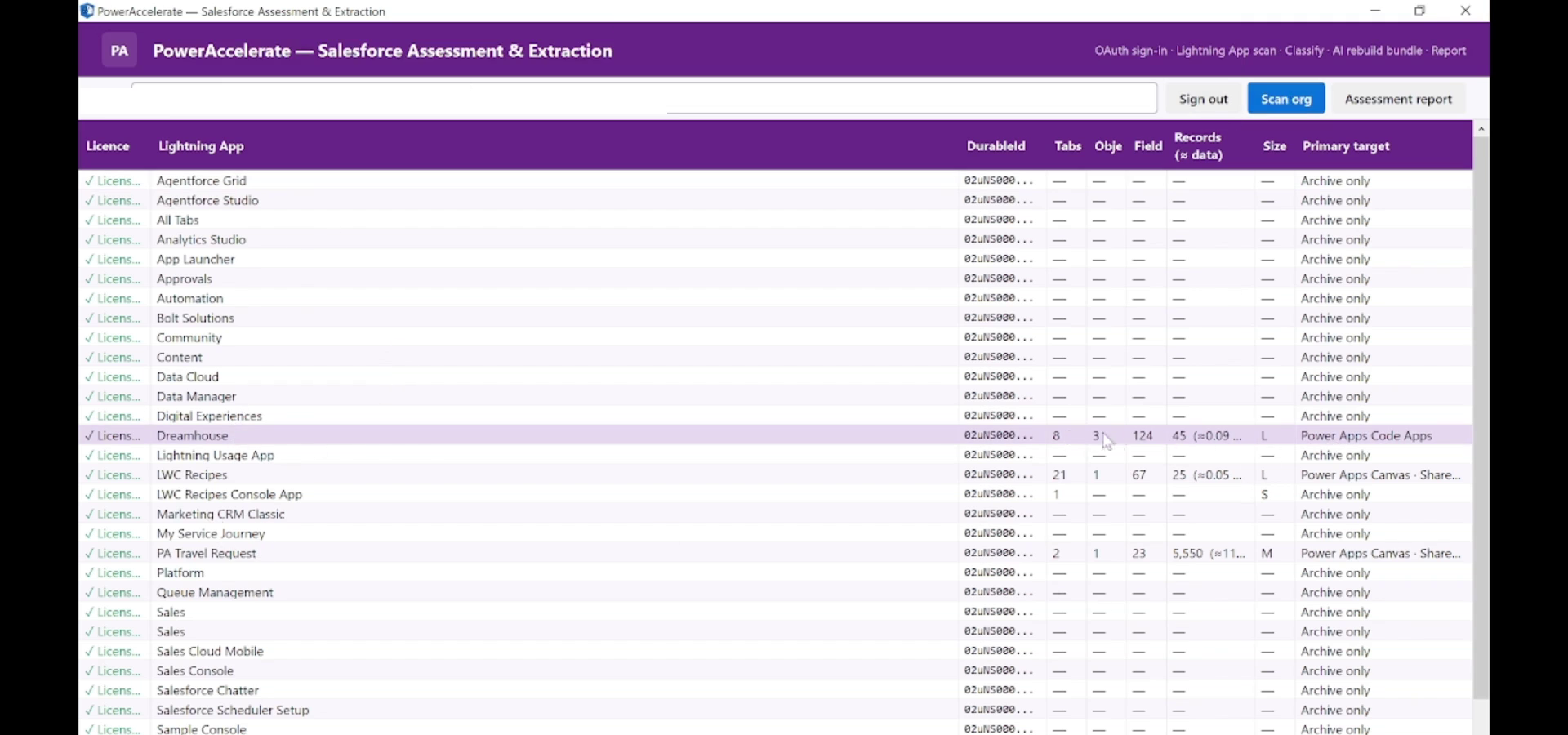
Main assessment view - full object inventory with T-shirt sizing, signal detection, and per-object licence state
Live Org Discovery
Sign in to a Salesforce production or sandbox org with the standard OAuth flow - no managed package, no installs in the org. The tool walks every object, every Flow, every Apex class, every LWC and Visualforce page via REST and Tooling API.
Deep Design Analysis
Beyond surface metadata. The tool inspects sObjects, fields, page layouts, record types, validation rules, Flows, Process Builder, Apex classes / triggers, LWC components, Visualforce pages, permission sets and sharing rules - giving you a true picture of complexity per object before migration planning.
Professional Reports
Stakeholder-ready reports in HTML, Excel and JSON. Every scan result is structured for immediate use in migration planning, governance reviews, executive briefings - or as the canonical input to the AI rebuild step.
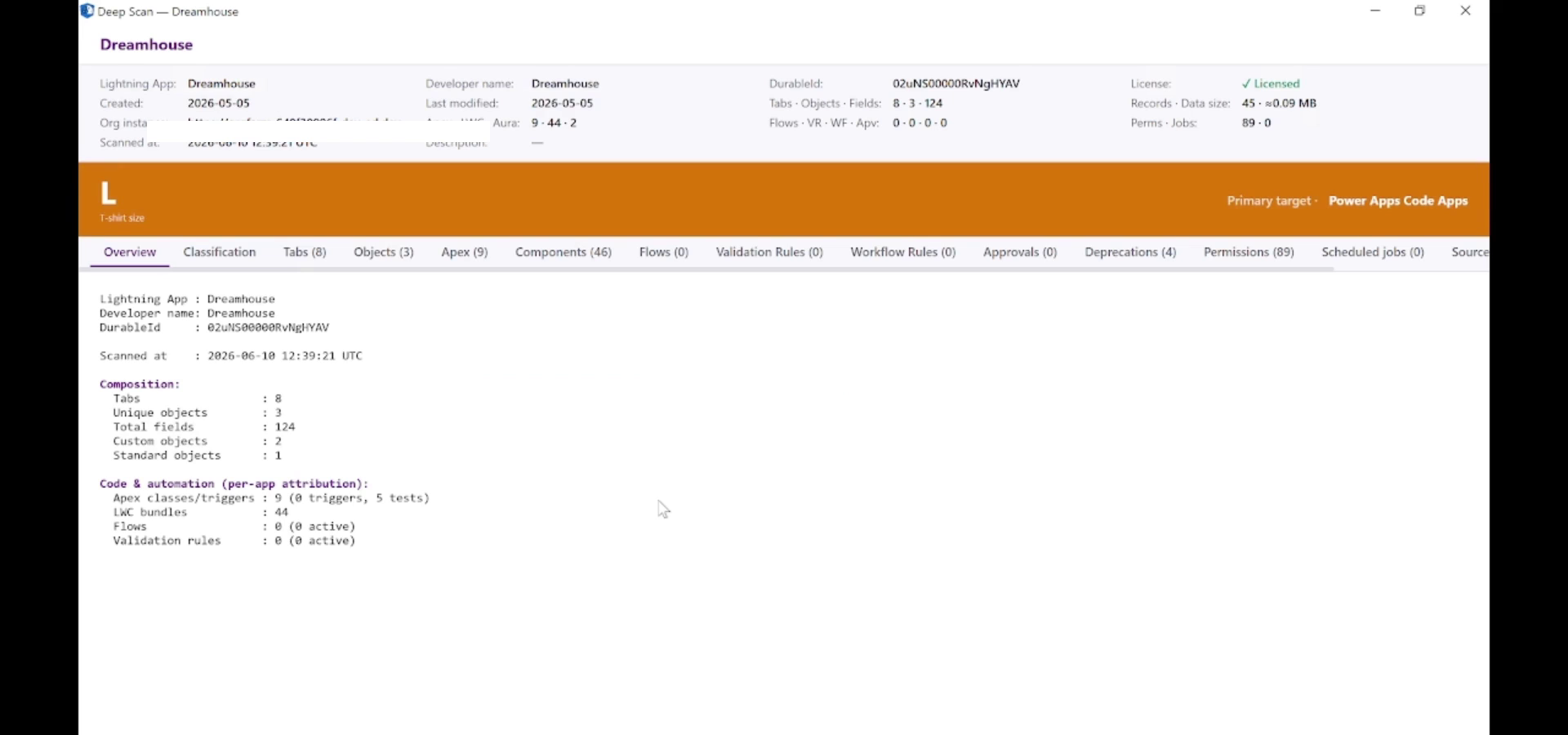
Drill into any object - T-shirt size, recommended Power Platform target, structure counts, live-data signals, and identity flags at a glance
How It Works
Four Steps to Full Visibility
From sign-in to report, the entire workflow is designed to be fast, safe, and non-invasive.
Connect
Sign in to a Salesforce production or sandbox org with the standard OAuth flow. Read-only profile, no installs in the org, no service-account credentials shared.
Discover
The tool walks every standard and custom object, every Flow, every Apex class and trigger, every LWC and Visualforce page, every page layout, record type, validation rule and permission set via REST and Tooling API.
Scan
Each object is profiled: fields, record counts, page layouts, automation count, Apex coverage, LWC dependencies. Read-only - nothing is modified in the org.
Report
Generate HTML, Excel and JSON reports with T-shirt sizing, fusion signals, recommended Power Platform targets, and a per-object migration plan.
Deep Scan
Five Dimensions of Analysis
Each object is analysed across five critical dimensions. Deep Scan reveals the true structure and complexity of every part of your Salesforce org - exactly what AI rebuild needs as input.
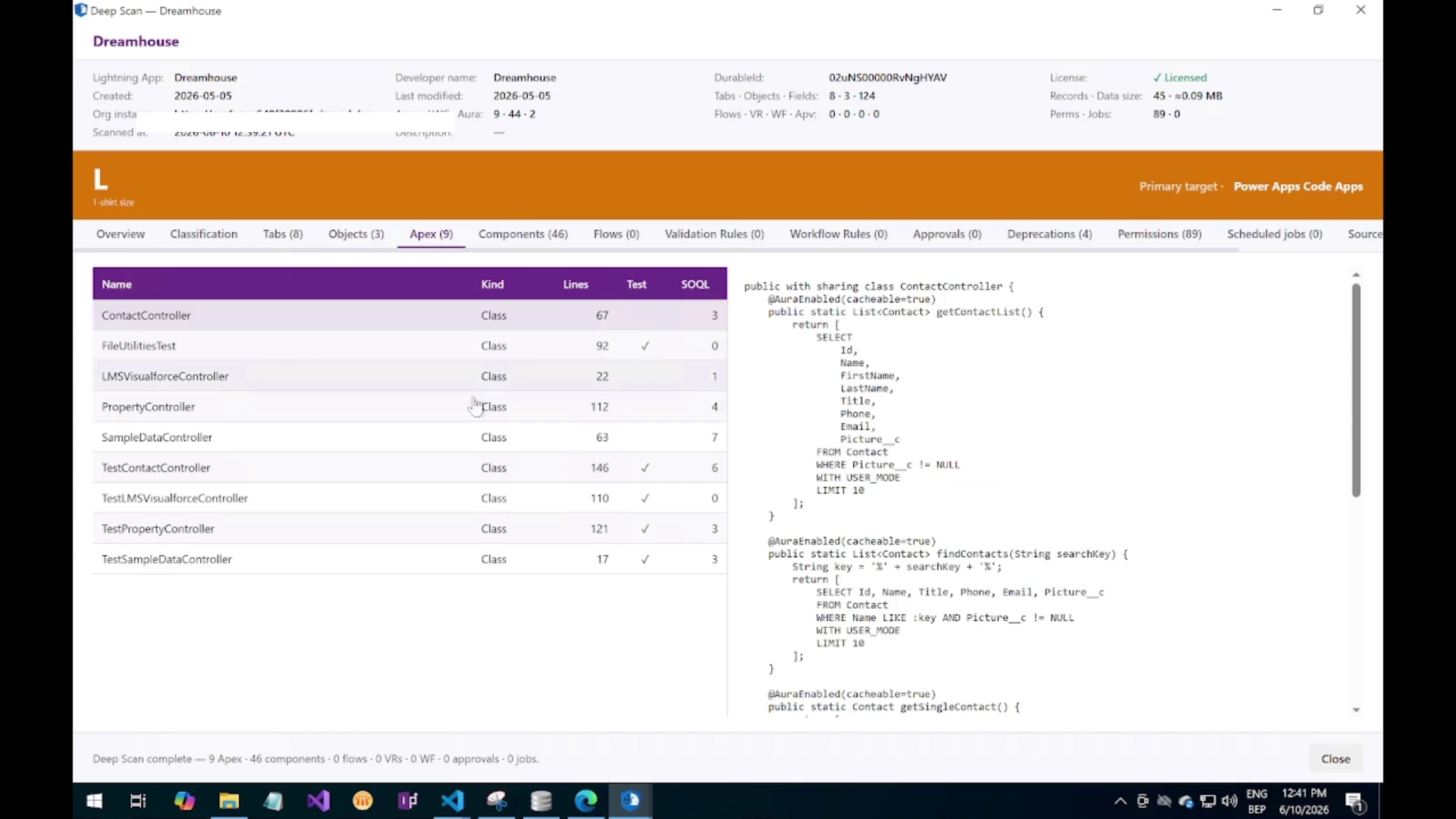
Fields & Schema - full sObject field tree
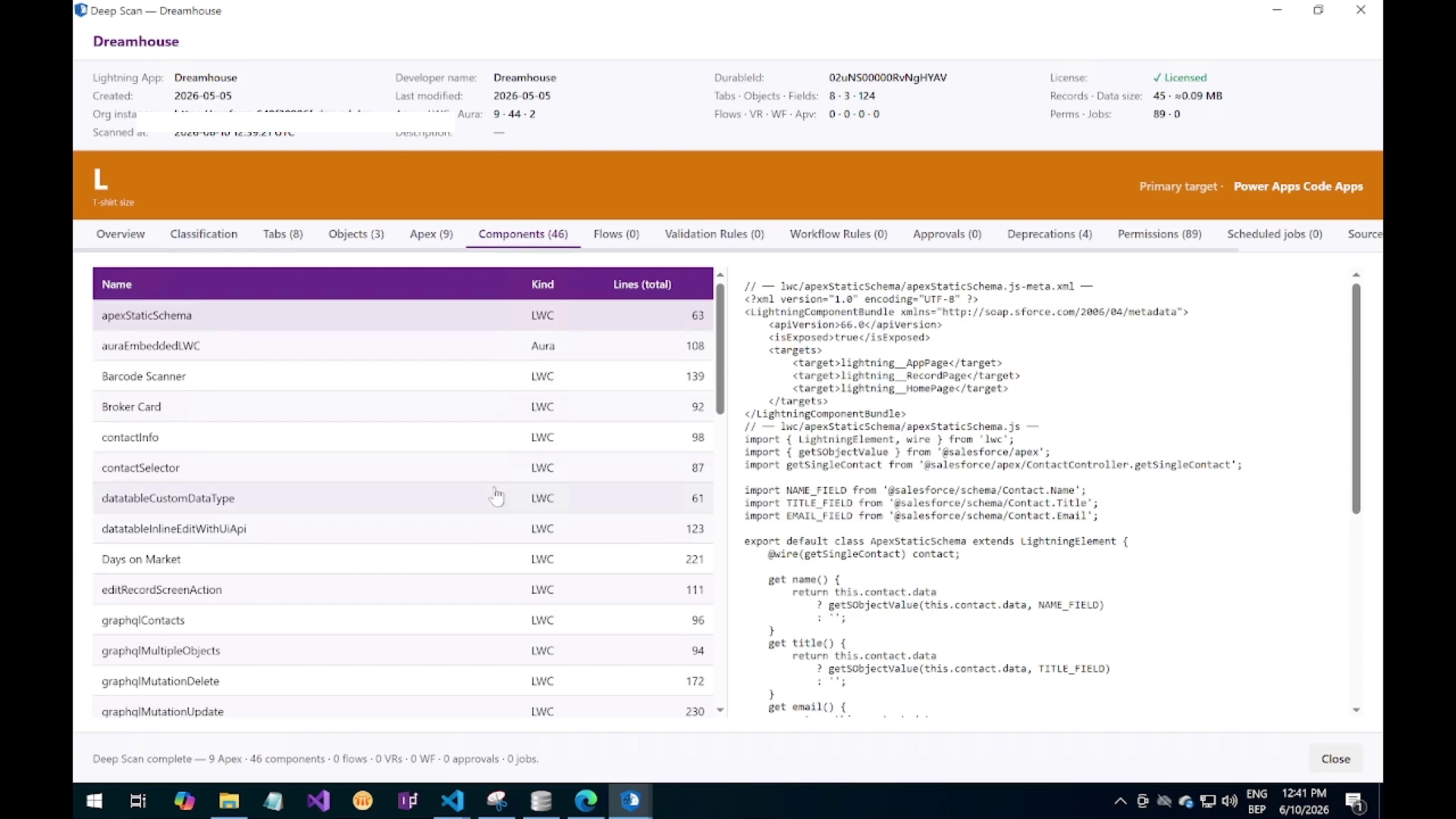
Components - Lightning Web Components and Aura sources
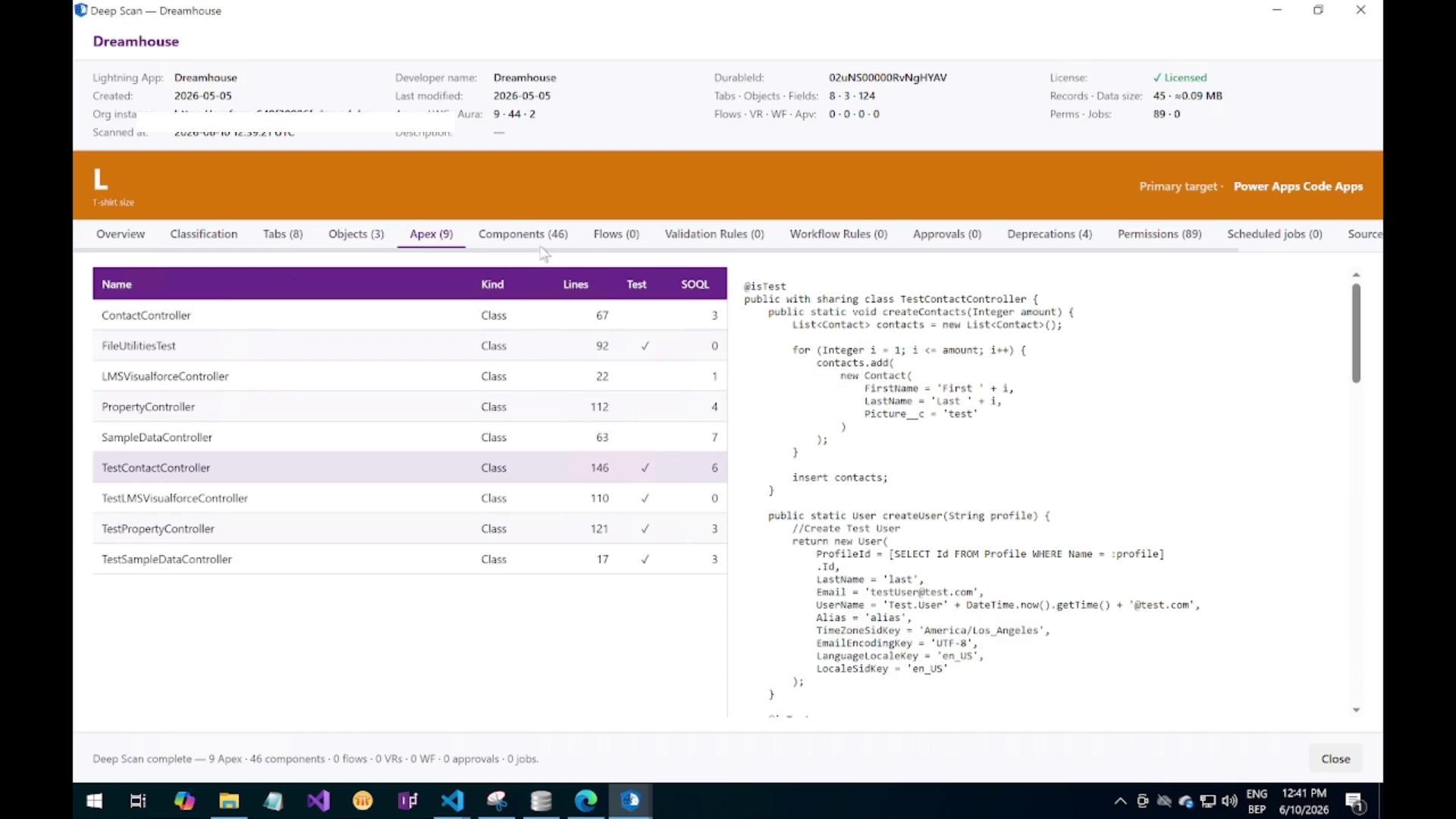
Apex & LWC - source, classes, triggers, components
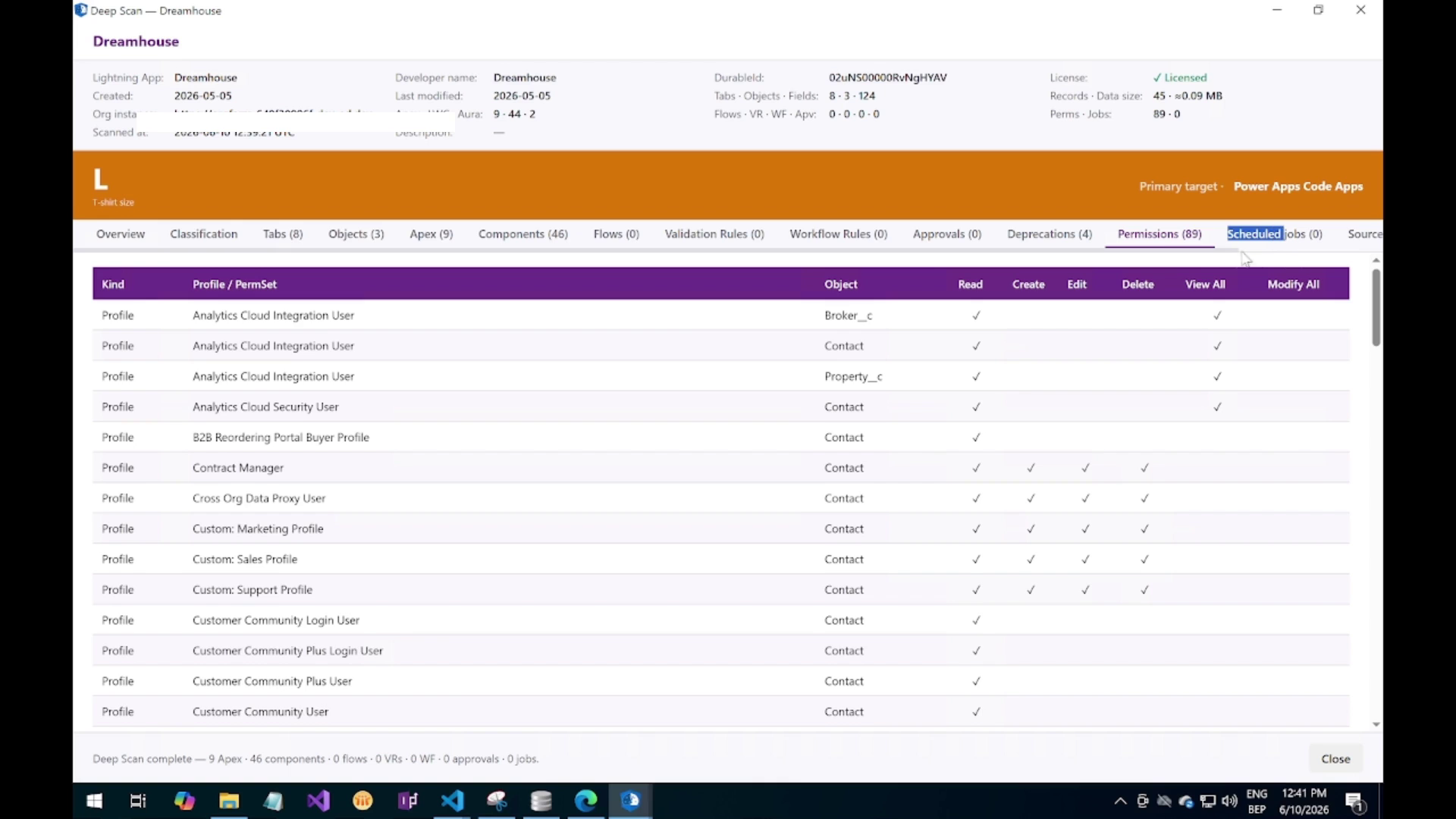
Permissions & Sharing - profiles, perm sets, sharing rules
Objects & Fields
Every standard and custom sObject, every field, every lookup and master-detail relation, every record type and page layout. Field types, default values, formulas, length constraints - the foundation for mapping to Dataverse or SharePoint Lists.
Flows & Automation
Flow Builder flows, Process Builder, Workflow Rules, scheduled jobs. Every automation parsed into a structured tree the AI rebuild step can translate to Power Automate flows.
Apex & LWC
Apex classes, triggers, batch jobs, queueables. Lightning Web Components, Visualforce pages, Aura components. Source captured, line-counted, and flagged with target-Power-Platform-equivalent suggestions.
Validation & Rules
Validation rules, formula fields, roll-up summaries, approval processes. Each parsed and surfaced for rewrite as Power Fx, Dataverse business rules, or Power Automate logic.
Permissions & Sharing
Profiles, permission sets, sharing rules, role hierarchy, criteria-based sharing. Mapped to Dataverse security roles, business units, and Microsoft Entra ID groups.
Extraction
Full Extraction, Not Just Metadata
Assessment tells you what you have. Extraction gets it out. The tool pulls every record across every object into a portable, queryable SQLite archive - schema-aware, attachment-aware, audit-aware. Salesforce records are hard to extract cleanly because of master-detail trees, ContentDocument files, history tables and formula fields. The tool handles it.
Records & Fields
Every record from every object, queried via Bulk API where it matters. Field values, lookups, formula evaluations, multi-select picklists - preserved with original structure intact, one row per record per object.
Files & Attachments
ContentDocument, ContentVersion, Attachment, and inline image references captured per record. File metadata (filename, size, content type, version chain) goes into SQLite; bytes opt-in to materialize locally as a content-addressed blob store.
Metadata & Layouts
Page layouts, record types, list views, compact layouts, lightning app pages - pulled from the Metadata + Tooling APIs alongside the data, joined into the same export run for full reconstruction context.
Flows & Apex
Flow XML, Apex source, LWC bundles, Visualforce pages, custom labels - captured as portable files alongside the data. Source-of-truth for the AI rebuild step.
Reports & Dashboards
Saved reports, dashboards, report folders and filter logic - captured so equivalent Power BI / Dataverse view definitions can be generated downstream.
Portable Output
One SQLite database per export run, one table per sObject, one row per record. Plus a Markdown manifest documenting every column. Queryable, archive-grade, Power-Platform-ready.
End-to-End Flow
Almost Fully Automated
Salesforce Modernization
The canonical shape of every engagement: Assess → Extract → Generate → Deploy. Each step feeds the next. Extracted records, metadata, Flows, Apex and LWC bundles flow into an AI pipeline that generates a working replacement on Power Platform - with migrated data included. No manual schema mapping. No rebuilding from scratch.
1. Assess
Full org scan - objects, fields, Flows, Apex, LWC, validation rules, permissions, record counts
2. Extract
Records, files, Flow XML, Apex source and metadata exported as portable SQLite + AI-ready bundle
3. Generate
AI reads the bundle and generates the Dataverse schema, the application, and the data-migration steps
4. Deploy
Your modern Power Platform app - with migrated data - deployed to Dataverse, SharePoint, or a Code App
Migration Framework
Categorize, Scope & Prioritize
AI-powered assessment gives you the full picture before you start. Each custom object is evaluated and routed through a decision framework.
Still in use?
If NO → Archive records or decommission the object.
Data relevant?
If YES → Archive to SQLite or Copilot Studio for retrieval.
Simple object?
Lift to a Dataverse table with a Model-Driven app, or to SharePoint Lists with a Canvas app.
Medium-complex?
Rebuild with Power Accelerate + AI - Flows, Apex, LWC, integrations.
Target platform?
Dataverse, SharePoint Lists, Power Apps, Power Automate, Copilot Studio, Code Apps.
Migration Targets
Remove
Decommission objects no longer in use. Archive any historical records worth keeping; clean up the org.
Preserve
Archive records to SQLite or a Copilot Studio knowledge base - for objects not in use but with data that must survive.
Simple Migrate
Lift to Dataverse + Model-Driven, or to SharePoint Lists + Canvas - simple in-use objects with limited automation and no Apex.
Complex Rebuild
Migrate with Power Accelerate + AI - medium-complex objects with Flows, Apex, LWC, validation, or integrations.
Why PowerAccelerate
Built for Real-World Migration
Non-Invasive
The tool performs read-only operations. No records are modified, no Flows are triggered, no managed package installed in your org. Safe to run against production.
Pause & Resume
Org-scale extractions can be paused and resumed at any time. Per-object checkpointing means a 5-million-record run never restarts from zero after a network blip or API limit.
Sandbox or Production
Run against a sandbox for the rehearsal, against production for the real cut-over. Same engine, same fidelity, two operating contexts.
Per-Org Licensing
Licences are bound to a Salesforce org's instance ID - not its name. Renaming a sandbox doesn't grant free extractions, and a customer always knows exactly which orgs are covered by which key.
Storage Intelligence
Record counts, file storage estimates, per-object footprints. Make informed decisions about what to migrate, archive, or decommission - backed by actual numbers, not gut feel.
Migration-Ready
Every output is structured for the next step. HTML reports for stakeholders, Excel for project planning, JSON for automation pipelines, AI rebuild bundles for downstream code generation.
Recommended Approach
Your Migration Journey
01 - Pilot
Rapid Proof of Value. Pick one or two real custom objects, prove the extraction quality, get an AI-rebuilt Power Platform replacement in front of end users in days, not months.
02 - Assessment
Full Inventory & Analysis. Org-wide scan with categorisation, T-shirt sizing, and per-object target recommendations. Know exactly what's ahead, what it costs to leave, and what it costs to move.
03 - Execution
Scale with AI. Decommission the dead, archive the inactive, lift the simple, rebuild the complex. AI does the heavy lifting; humans review and approve.
Get Started
Ready to Cut
Your Salesforce TCO?
Let AI do the heavy lifting. Extract, assess, and rebuild on Power Platform - in a fraction of the time, at a fraction of the licensing cost. Reach out for a demo or to discuss your Salesforce estate.